
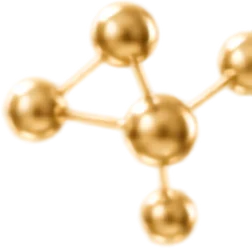
Proprietary technology
EXOSIGNAL™
Directed exosomal signaling.
A conventional biostimulator deposits a substrate and waits for the cell to react. EXOSIGNAL™ adds the missing layer: the biomimetic exosome carries the message that tells the fibroblast what to build, how much and in what order. The result is not more stimulation but stimulation with direction.

Anatomy
What an exosome is
A nanovesicle that cells use to communicate with one another. It is not an active ingredient but a vehicle for information, which is why the cell follows it instead of simply absorbing it.
in diameter
that the cell recognizes
and growth factors
directed, between cells
How it works
From signal to execution
Encapsulation
The biomimetic exosome is stabilized by vacuum freeze-drying, keeping its membrane and signaling load intact.
Recognition
The target cell recognizes the structure of its membrane, which allows selective rather than random delivery.
Instruction
It releases its load of biological mediators, and the cell receives the order to activate the right regenerative pathway.
Execution
The activated fibroblast uses the executing active as its substrate and synthesizes collagen progressively and in order.
Evolution
The evolution of biostimulation
Where this technology stands compared with everything available on the market today.
1st generation
Hyaluronic acid
Hydrates and fills: a temporary physical effect with no biological activity.
2nd generation
Biostimulators
Trigger a fibroblast response. Real stimulation, but without direction.
3rd generation
Exosomes alone
Signal the cell: an instruction without a substrate to build with.
4th generation
EXOSIGNAL™
Signal + substrate in the same protocol. Directed biology.
Without directed signaling
The active reaches the tissue and the response depends on each patient's biological chance. Stimulation without instruction; uneven results from one patient to the next.
With EXOSIGNAL™
The active arrives together with the instruction. The cell knows what to do with it. A more predictable, more orderly and more physiological response.
Others deliver the active. EXOSIGNAL™ delivers the instruction.
The supporting actives
In GHK-Cu and PLLA, and they do more than it seems
Reduced glutathione
An antioxidant tripeptide the body produces itself.
- Neutralizes free radicals
- Inhibits tyrosinase → less melanin
- Even tone and radiance
Low-molecular-weight hyaluronic acid
Not the same HA used in a filler: its smaller size penetrates deeper.
- Hydrates the dermis, not just the surface
- Creates the ideal environment for regeneration
The advantage
Why this was not on the market
01
Exosomes are sold on their own
A signal without a substrate: the cell gets the order but has nothing to carry it out with.
02
Biostimulators are sold on their own
A substrate without a signal: material without instruction and a variable response.
03
Aethera combines them in one protocol
This requires a stable formulation of both in the same freeze-dried vial.
Frequently asked questions
What people ask us most
What is an exosome?
It is a 30–150 nanometer nanovesicle that cells use to communicate with one another. It has a lipid membrane that the cell recognizes and carries microRNA, messenger RNA, proteins and growth factors.
What do exosomes do for the skin?
They act as messengers between cells, carrying signals that support tissue repair, collagen synthesis, inflammation control and recovery after procedures such as laser, peels or microneedling. At Aethera they are combined with an executing active (GHK-Cu, PLLA or PDRN) so the signal has something to build with.
What does “fourth generation” mean?
The first generation was hyaluronic acid (a physical effect), the second was biostimulators (stimulation without direction) and the third was exosomes alone (a signal without a substrate). EXOSIGNAL™ brings the signal and the substrate together in the same protocol.
Why are the products freeze-dried?
Vacuum freeze-drying stabilizes the exosome while keeping its membrane and signaling load intact. As a result, the product needs no cold chain before reconstitution and remains stable for 24 months.
Technical guides
Learn more
What exosomes are and what they do for the skin
What an exosome is, how it communicates with skin cells, what it is used for in aesthetic medicine and how it differs from a conventional active ingredient.
Read guide ExosomesExosomes vs. stem cells: how they differ
The differences between exosomes and stem cells in aesthetic medicine: what they are, how they act, why they are not the same and what it means in practice.
Read guideWhere to buy
For twenty years we put things into the skin. Now we tell it what to do.
The Aethera Mésolab line is sold exclusively through authorized distributors.