
Fourth-generation regenerative biostimulation
Exosomes +
poly-L-lactic acid
The first biostimulator that does more than stimulate. It instructs.
Biomimetic exosomes and poly-L-lactic acid in the same protocol. PLLA builds the patient's own collagen; the exosome tells the fibroblast how to do it. Stimulation with biological direction.
signaling technology Fourth generation
What no other biostimulator has
Three differences you can explain in one consultation and see on the skin.
01
Signal + structure
A conventional biostimulator triggers a response and waits. Here the exosome acts as a cellular messenger, so neocollagenesis happens in a directed, physiological way rather than as a simple inflammatory reaction.
02
A result that builds up
PLLA induces a gradual fibroblast response with type I collagen synthesis. It is not filler; it is the patient's own tissue. That is why the result does not deflate but keeps maturing for months.
03
Glutathione in the same formula
A built-in antioxidant. While the dermis gains density and firmness, the skin gains radiance and a more even tone. Two goals, one procedure.
Composition
What poly-L-lactic acid is
A biodegradable polymer from the alpha-hydroxy acid family. It does not fill: it teaches the skin to make its own collagen.
Same family as absorbable sutures
Decades of documented surgical use before reaching aesthetic medicine.
Fully biodegradable
It is metabolized into carbon dioxide and water. No residual material remains.
Not a filler
It adds no volume by itself: it prompts the tissue to create it.
Mechanism
How it builds collagen
1
Deposit
The microparticles settle in the dermis.
2
Response
A controlled subclinical inflammatory response is generated.
3
Activation
Macrophages encapsulate the particle and activate the fibroblast.
4
Synthesis
The fibroblast synthesizes new type I collagen.
5
Remodeling
The polymer breaks down; the collagen remains.
That is why the result does not deflate: what remains is not product, it is the patient's own tissue.
Expected results
Biological response curve
Expected behavior over a full cycle of 3 sessions (1 box).
- Wk 1–2
Immediate radiance and hydration
Hyaluronic acid and glutathione act first. The skin feels fresh from session 1.
- Wk 4–6
Finer texture and pores
The extracellular matrix begins to reorganize.
- Wk 8–12
Real firmness and density
Neocollagenesis becomes evident. Tissue support and elasticity improve.
- Mo 4–6
Rejuvenation that matures
The newly formed collagen keeps remodeling. This is the ideal time for maintenance.
Mechanism of action
Four actives, one response
Biomimetic exosomes
Nanovesicles that support cell-to-cell communication, tissue repair and skin regeneration.
Poly-L-lactic acid (PLLA)
A dermal biostimulator that induces a gradual fibroblast response and type I collagen synthesis: firmness, elasticity and density.
Reduced glutathione
An antioxidant that lowers oxidative stress, boosts radiance and helps even out skin tone.
Hyaluronic acid + CMC
Deep hydration and an optimal biological microenvironment for dermal regeneration.
Indicated for
An adjunct in professional protocols
- Comprehensive facial rejuvenation
- Mild to moderate laxity
- Loss of dermal density
- Photoaging
- Loss of tissue support
- Enlarged pores
- Uneven texture
- Devitalized skin
Benefit record
Benefit, mechanism and visible result
| Benefit | Biological mechanism | What the patient sees |
|---|---|---|
| Real firmness | Type I neocollagenesis induced by PLLA | A more defined facial contour, skin with support |
| Dermal density | More of the patient's own extracellular matrix | Skin feels thicker, not tighter |
| Progressive effect | Collagen keeps forming after the last session | Improvement that continues for months |
| Refined pores | Reorganization of the superficial matrix | Even texture, skin that reflects light better |
| Radiance | Glutathione reduces oxidative stress | A rested face, not an “overdone” one |
| Body application | The same mechanism in the dermis of other areas | Arms, abdomen, buttocks and legs |
Suggested protocol
Adjustable according to professional assessment
Treatment areas
- Face
- Neck
- Décolleté
- Hands
- Arms
- Abdomen
- Buttocks
- Legs
Application techniques
- Advanced facial mesotherapy
- Cannula infiltration
- Professional microneedling
- Dermapen
- Intradermal micro-injection
Where it fits in your protocol
If your patient already uses… Aethera adds
The case compared with what your patient already uses.
Hyaluronic acid skin booster
Structure, not just water. HA hydrates; PLLA builds the patient's own collagen to support the tissue.
Botulinum toxin
Skin quality. The toxin relaxes the muscle; this improves the dermis above it. They enhance each other.
Thread lifts
Density that supports. Improves the dermal bed and extends how long the thread result lasts.
Nothing regenerative yet
The entry point. A visible, progressive result without changing the patient's features.
Specifications
Technical data
| Presentation | 6 vials per box |
|---|---|
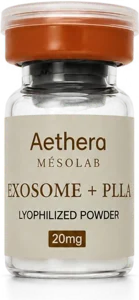
| Contents | 3 × 20 mg freeze-dried + 3 × 5 ml diluent |
| Yield | 1 box = 3 complete sessions |
| Technology | EXOSIGNAL™ · directed exosomal signaling |
| Dosage form | Freeze-dried powder + sterile diluent |
| Freeze-dried appearance | White porous solid |
| Diluent appearance | Clear, colorless solution |
| Reconstituted product | Homogeneous milky-white suspension |
| Before reconstitution | Cool, dry place, protected from light |
| After reconstitution | 2 °C to 8 °C · use within 7 days |
| Shelf life | 24 months |
Composition
What each vial contains
Freeze-dried powder · 3 vials × 20 mg
Biomimetic exosomes · poly-L-lactic acid (PLLA) · reduced glutathione · D-mannitol · trehalose
Sterile diluent · 3 vials × 5 ml
Sodium hyaluronate · carboxymethylcellulose (CMC) · PBS buffer · water for injection
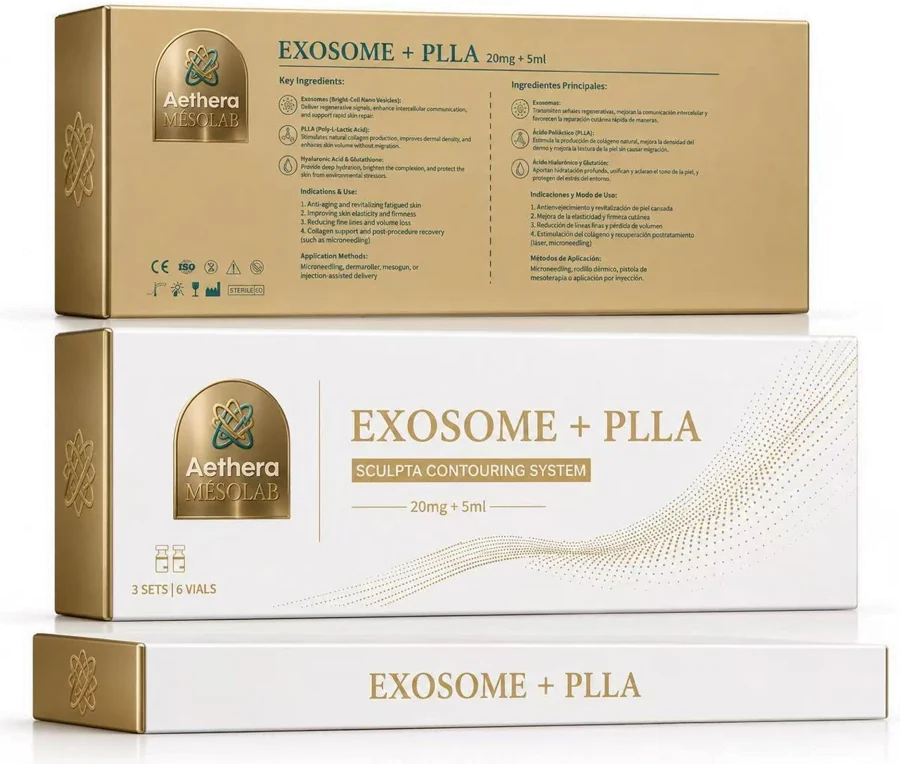
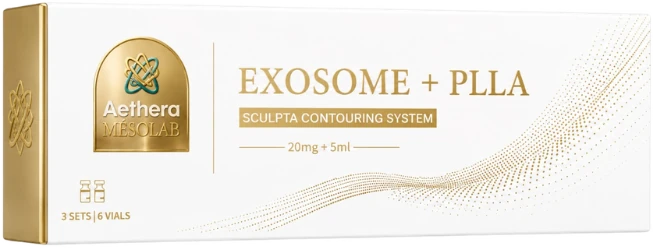
The packaging
Everything essential, printed on the box
Each box lists the key ingredients, directions for use and application methods in Spanish and English. 3 sets · 6 vials, with lot and expiry on every vial.
- Microneedling
- Dermaroller
- Mesotherapy gun
- Injection-assisted delivery
1 box= 3 complete sessions
One box. One complete cycle. Zero waste.6 vials: 3 of product and 3 of diluent. The 3-session protocol fits exactly in one box and treats face or body from the same inventory.
Directions for use and contraindications
Indication, application technique, volume administered and frequency must be individualized according to the treating professional's assessment, dermal quality and each patient's goals. Apply only with the technique and depth for which you hold certified training. Reconstitute under strictly aseptic conditions by adding the diluent to the freeze-dried vial and mixing gently until a homogeneous suspension forms; avoid excessive shaking. Do not administer intravascularly.
Avoid intense sun exposure, excessive heat, saunas and vigorous massage during the first 48 hours. Inform the patient that transient erythema, mild edema or self-limiting inflammatory nodules may appear.
Contraindicated in: hypersensitivity to any component, pregnancy and breastfeeding, minors, active infection in the area, acute inflammatory processes, open wounds, active autoimmune disease, coagulation disorders and uncontrolled diabetes mellitus, and a tendency to form keloids.
Frequently asked questions
Exosome + PLLA
How is it different from a conventional biostimulator?
A conventional biostimulator deposits a substrate and waits for the tissue to react. Exosome + PLLA adds biomimetic exosomes that tell the fibroblast what to build, for more orderly, physiological neocollagenesis.
When are results visible?
Hydration and radiance show from the first session; texture improves between weeks 4 and 6, firmness and density between weeks 8 and 12, and the collagen keeps maturing until months 4 to 6.
Can it be used on the body?
Yes. It is indicated for 8 areas: face, neck, décolleté, hands, arms, abdomen, buttocks and legs.
How often is it applied?
1 session every 4 weeks for 3 sessions (1 box), with maintenance every 3 to 6 months per assessment.
Technical guides
Learn more
Collagen biostimulators: types, differences and how to choose
What a collagen biostimulator is, the main types (PLLA, calcium hydroxylapatite, polycaprolactone, exosomes + PLLA), how they work and how to choose the right one.
Read guide BiostimulationPoly-L-lactic acid (PLLA): what it is, how it works and when results show
What poly-L-lactic acid (PLLA) is, how it stimulates collagen, when results appear, its pros and cons, and why to combine it with exosomes.
Read guide BiostimulationCollagen biostimulator for buttocks, abdomen, arms and legs
How a collagen biostimulator is used on the body: buttocks, abdomen, arms, legs, neck and hands. Indications, expectations, protocol and aftercare.
Read guideWhere to buy
For twenty years we put things into the skin. Now we tell it what to do.
The Aethera Mésolab line is sold exclusively through authorized distributors.