
Advanced repair and brightening system
Exosomes + GHK-Cu
Repairs what others only hydrate.
Exosomes, copper tripeptide, glutathione and low-molecular-weight hyaluronic acid. Cell signaling that directs true repair of the skin barrier, even in skin that no longer tolerates anything else.
signaling technology Fourth generation
What no other skin repairer has
Three reasons this vial fits protocols where nothing else does.
01
Signal + repair
The exosomes direct the cellular response and GHK-Cu carries it out: type I and III collagen, elastin and extracellular matrix remodeling. The instruction and the tool in a single protocol.
02
Goes where nothing else can
Modulates inflammation and strengthens barrier function. It is the product for the active patient with persistent erythema or a compromised barrier who has already told you everything irritates her skin.
03
Radiance without aggression
Glutathione neutralizes free radicals and evens out skin tone. Visible results on dyschromia and superficial hyperpigmentation without resorting to irritating actives.
Composition
What copper tripeptide is
GHK-Cu is three amino acids bound to a copper ion. Nothing more, nothing less. It was isolated from human plasma in 1973: it is not a foreign molecule but one the body already knows.
The fact that explains it all
The peptide the body makes on its own… and stops making with age
Skin does not stop repairing itself because it aged. It ages because it stopped receiving the signal to repair.
Synthesis
Stimulates type I and III collagen, elastin, glycosaminoglycans and proteoglycans.
Balance
Modulates metalloproteinases (MMPs) and their inhibitors (TIMPs), slowing degradation while it builds.
Antioxidant
Copper is a cofactor of superoxide dismutase (SOD), one of the body's antioxidant defenses.
Repair
Supports fibroblast migration and angiogenesis during healing.
Anti-inflammatory
Modulates the inflammatory response, which is key for reactive or post-procedure skin.
Evidence
Mechanisms described in the scientific literature on the GHK-Cu peptide.
Expected results
Biological response curve
Expected behavior over a cycle of 3 to 5 sessions every 14 days.
- Session 1
Calmer, visibly hydrated skin
Redness and tightness decrease from the first application.
- Session 2–3
Even tone, noticeable radiance
Glutathione works on dyschromia and dullness.
- Session 4–5
Better texture, stronger barrier
GHK-Cu remodels the extracellular matrix and fine lines soften.
- Post-proc.
Noticeably faster recovery
After laser, peels or microneedling it shortens downtime.
Mechanism of action
Four actives, one response
Bioactive exosomes
Nanovesicles carrying proteins, growth factors and microRNA: cell-to-cell communication, tissue regeneration and inflammation control.
GHK-Cu · copper tripeptide-1
Stimulates fibroblasts, type I and III collagen and elastin. Remodels the extracellular matrix and reduces oxidative stress.
Glutathione
A key intracellular antioxidant: neutralizes free radicals, protects against photoaging and evens out skin tone.
Low-molecular-weight hyaluronic acid
Its small size helps it penetrate tissue: deep hydration and better barrier function.
Indicated for
An adjunct in professional protocols
- Mild to moderate photoaging
- Facial rejuvenation
- Superficial fine lines
- Loss of radiance
- Post-laser recovery
- Post-microneedling
- Superficial hyperpigmentation
- Post-chemical peel
- Acne marks
- Sensitive or reactive skin
- Persistent erythema
- Compromised skin barrier
Benefit record
Benefit, mechanism and visible result
| Benefit | Biological mechanism | What the patient sees |
|---|---|---|
| Repaired barrier | GHK-Cu restores the extracellular matrix and barrier function | Less tightness, less stinging, skin that tolerates treatment |
| Less redness | Modulation of the inflammatory response | A visibly calmer face |
| Even tone | Glutathione inhibits tyrosinase and reduces melanin | Faded spots, even radiance |
| Refined texture | Synthesis of type I and III collagen + elastin | Skin that looks and feels smoother |
| Fast recovery | Angiogenesis and fibroblast migration | Fewer days of post-procedure downtime |
| Deep hydration | Low-molecular-weight HA penetrates deeper | Lasting turgor, not just surface moisture |
Suggested protocol
Adjustable according to professional assessment
Treatment areas
- Face
- Neck
- Décolleté
- Hands
Application techniques
- Superficial mesotherapy
- Intradermal injection
- Microneedling
- Dermapen
- Mesotherapy gun
- Professional dermal roller
Where it fits in your protocol
If your patient already uses… Aethera adds
The clinical case compared with what your patient already uses.
Laser, peels or microneedling
Faster recovery. Improves the final result of the base procedure and reduces downtime.
Topical depigmenting agents
Action from the dermis. Works on tone without irritating or compromising the skin barrier.
Hyaluronic acid skin booster
True repair. It does more than hydrate the surface: it rebuilds barrier function and the extracellular matrix.
Nothing: skin is too reactive
The protocol it does tolerate. Calms, repairs and prepares the skin for later treatments.
Specifications
Technical data
| Presentation | 6 vials per box |
|---|---|
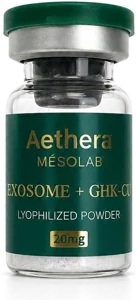
| Contents | 3 × 20 mg freeze-dried + 3 × 5 ml diluent |
| Yield | 1 box = 3 complete sessions |
| Dosage form | Freeze-dried powder + sterile diluent |
| Freeze-dried appearance | Blue powder |
| Diluent appearance | Clear, colorless solution |
| Reconstituted product | Clear, pale blue solution |
| Before reconstitution | Cool, dry place, protected from light |
| After reconstitution | 2 °C to 8 °C · use within 7 days |
| Shelf life | 24 months |
Composition
What each vial contains
Freeze-dried powder · 3 vials × 20 mg
Exosomes + GHK-Cu (copper tripeptide-1) · glutathione · D-mannitol
Sterile diluent · 3 vials × 5 ml
Low-molecular-weight sodium hyaluronate · PBS buffer · benzyl alcohol · water for injection
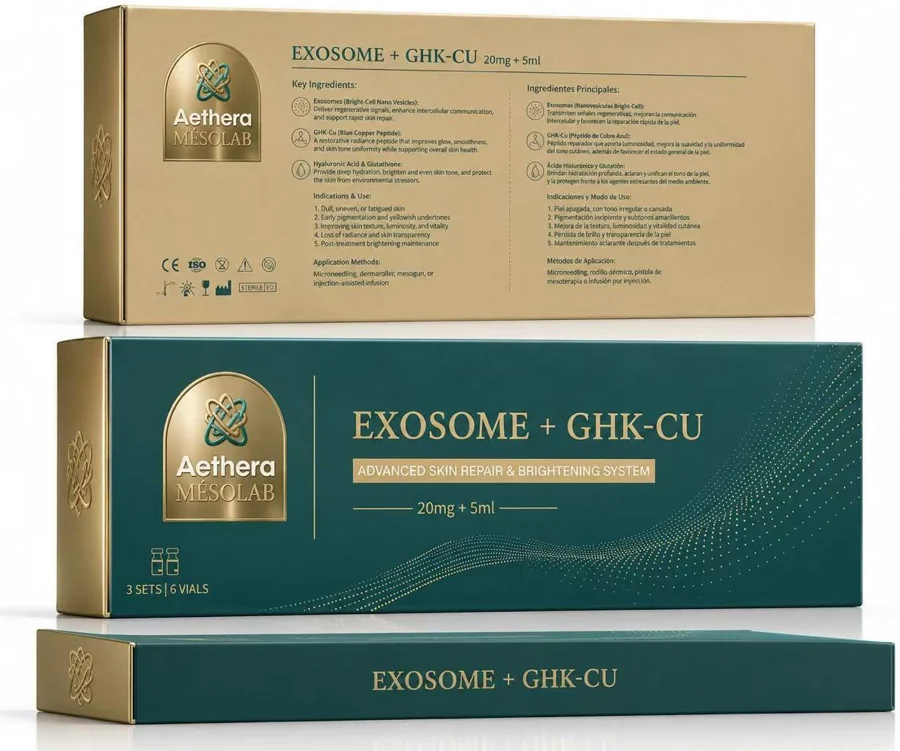
The packaging
Everything essential, printed on the box
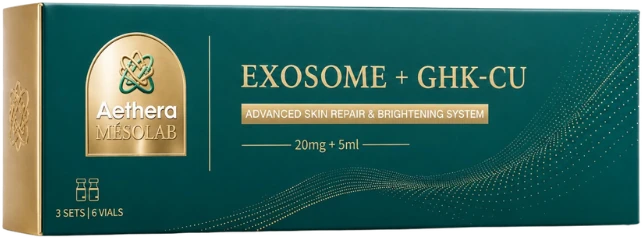
Each box lists the key ingredients, directions for use and application methods in Spanish and English. 3 sets · 6 vials, with lot and expiry on every vial.
- Microneedling
- Dermaroller
- Mesotherapy gun
- Injection-assisted infusion
1 box= 3 complete sessions
The complement to every procedure you already perform.Laser, peels, microneedling and biostimulation: every procedure on your schedule is a direct indication. No cold chain before reconstitution and 24 months of stability.
Directions for use and contraindications
Indication, application technique, volume administered and treatment frequency must be individualized according to the medical assessment, the patient's clinical condition and the therapeutic goals. Reconstitute by transferring the 5 ml of diluent into the freeze-dried vial and mix gently until fully dissolved, avoiding vigorous shaking.
During the first 24 hours: avoid intense sun exposure, saunas, steam baths and irritating cosmetics; use broad-spectrum sun protection.
Contraindicated in: hypersensitivity to any component, pregnancy and breastfeeding, minors, active infection in the area, acute inflammatory processes, open wounds, active autoimmune disease, coagulation disorders and uncontrolled diabetes mellitus.
Frequently asked questions
Exosome + GHK-Cu
Which patients is Exosome + GHK-Cu indicated for?
Sensitive or reactive skin, persistent erythema, a compromised barrier, superficial hyperpigmentation or mild to moderate photoaging, and as an adjunct after laser, peels or microneedling.
How often is it applied?
The suggested protocol is 1 session every 14 days over a cycle of 3 to 5 sessions, with maintenance per assessment. One box covers 3 sessions.
How should it be stored?
Before reconstitution, in a cool, dry place protected from light, with a 24-month shelf life. Once reconstituted, keep between 2 °C and 8 °C and use within 7 days.
Can it be combined with Exosome + PLLA?
Yes. It is recommended as the first phase: GHK-Cu repairs the barrier and prepares the tissue so that PLLA-driven neocollagenesis performs better.
Technical guides
Learn more
Facial exosomes: benefits, indications and results
The benefits of a facial exosome treatment, which patients it suits, how many sessions it takes and how the results develop over time.
Read guide ExosomesHow much an exosome treatment costs and what drives it
The factors that determine the price of an exosome treatment, how to calculate cost per session and what to check before comparing products.
Read guide ExosomesExosomes with microneedling, laser or peels: how to combine them
How to combine exosomes with microneedling, dermapen, fractional laser and chemical peels: timing, technique, benefits and precautions.
Read guideWhere to buy
For twenty years we put things into the skin. Now we tell it what to do.
The Aethera Mésolab line is sold exclusively through authorized distributors.